
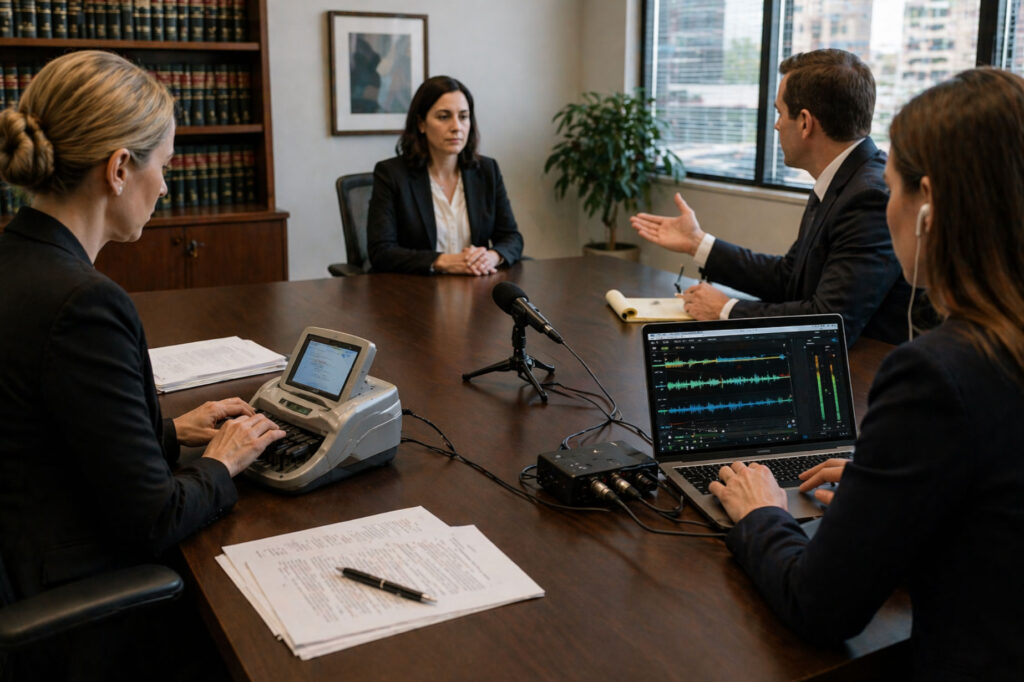
If you’ve ever needed a transcript of a deposition, hearing, arbitration, or public meeting, you’ve probably heard a handful of titles thrown around: court reporter, stenographer, digital reporter, voice writer. While these professionals use different methods to capture the spoken word, they all share the same goal: creating a complete, accurate, and reliable verbatim record of the proceeding.
Stenographic Court Reporters
Stenographic reporters capture testimony using a stenotype machine, which is a specialized keyboard that records speech phonetically through combinations of keystrokes rather than traditional typing. Those shorthand notes are then translated into readable text using computer software.
Stenography has been a foundational part of the legal profession for over a century and continues to be widely used in courts, depositions, arbitrations, hearings, and administrative proceedings. However, in the present day, the stenographic workforce is diminishing, as there are fewer stenographers entering the field and other methods of court reporting are being utilized.
Voice Writers
Voice writers use a handheld stenomask to quietly repeat everything spoken during a proceeding. Their speech is processed through specialized speech recognition software that converts their dictation into text in real time.
In addition to repeating testimony, voice writers identify speakers, mark exhibits, and note courtroom events, just as other court reporters do. Their method differs from stenography, but the objective remains exactly the same, creating a complete, verbatim legal record.
Voice writing is also commonly used for CART (Communication Access Realtime Translation) and live captioning services.
Digital Court Reporters
Digital court reporters use professional multi-channel recording systems to capture every participant on separate audio channels while actively monitoring the proceeding in real time. Throughout the hearing, they create detailed annotations identifying speakers, marking exhibits, noting objections, flagging technical terminology, verifying spellings and documenting important events.
Digital reporting involves far more than simply recording audio. A trained digital reporter continuously monitors sound quality, identifies potential issues as they occur, manages the record, and ensures every participant is captured clearly. Following the proceeding, the reporter reviews the recording and annotations throughout transcript production to help ensure an accurate final transcript.
Modern digital reporting has become an increasingly common solution for courts, government agencies, law firms, and administrative tribunals because it combines skilled professionals with advanced recording technology to produce reliable legal records.
Different Methods. Same Professional Responsibility.
Although each profession captures the spoken word differently, their responsibilities are fundamentally and ethically the same.
Whether using a stenotype machine, a stenomask, or professional digital recording equipment, qualified reporters are responsible for:
- Creating a complete and accurate verbatim record, ultimately becoming the official legal record
- Administering the oath and swearing in witnesses
- Remaining impartial throughout the proceeding
- Identifying speakers
- Clarifying terminology and noting procedural events
- Managing exhibits
- Monitoring and maintaining the integrity of the record
- Marking and tracking exhibits as they’re introduced
- Certifying the transcript as true and accurate
- Following all applicable court rules, agency requirements, and jurisdictional standards
The quality of a transcript is determined by the training, certification, experience, and professionalism of the reporter—not by the method used to capture the record.
“Certified” and “Real-Time” — Important Qualifications
One of the biggest misconceptions is that “certified” or “real-time” describes a separate type of reporter. In reality, these are qualifications rather than professions.
- Certified means a reporter has earned credentials through a recognized professional organization, such as the National Court Reporters Association (NCRA), the National Verbatim Reporters Association (NVRA), or the American Association of Electronic Reporters and Transcribers (AAERT). These certifications demonstrate competency and adherence to professional standards for producing legal transcripts.
- Real-time means text is delivered live as the proceeding unfolds, allowing attorneys, judges, and other participants to read testimony immediately. Depending on the reporting method, real-time may be produced through specialized equipment, speech recognition technology, or other approved technologies.
Choosing the Right Fit
There is no universal “best” reporting method because all three professions share the same mission: preserving an accurate, impartial, and complete record of legal proceedings.
The reporting method selected is often based on client preference, jurisdictional rules, contractual requirements, or the technology available for a particular proceeding. Regardless of whether the record is captured by a stenographic reporter, voice writer, or digital court reporter, each profession is dedicated to preserving an accurate, complete, and impartial verbatim record. The difference lies in the method used to capture testimony—not in the professionalism or quality of the final transcript.
What matters most is working with qualified professionals who understand the legal process and are committed to preserving the integrity of the record. That’s exactly where a technology-driven partner like eScribers excels—matching every proceeding with experienced reporters, modern technology, and proven workflows to deliver accurate transcripts on time, regardless of how the record is captured.
The Bottom Line
The legal reporting profession has evolved alongside technology, but its purpose has remained unchanged. Whether the record is captured through stenography, voice writing, or digital reporting, each method is designed to create an accurate, reliable, and trustworthy transcript.
Understanding these distinctions helps dispel common misconceptions. These professions are not defined by different levels of capability—they simply represent different methods of accomplishing the same essential responsibility: preserving the official record with accuracy, professionalism, and integrity. At the end of the day, the method may differ, but the goal is always the same: ensuring every word is captured and every proceeding is preserved with the highest standards of quality.
