
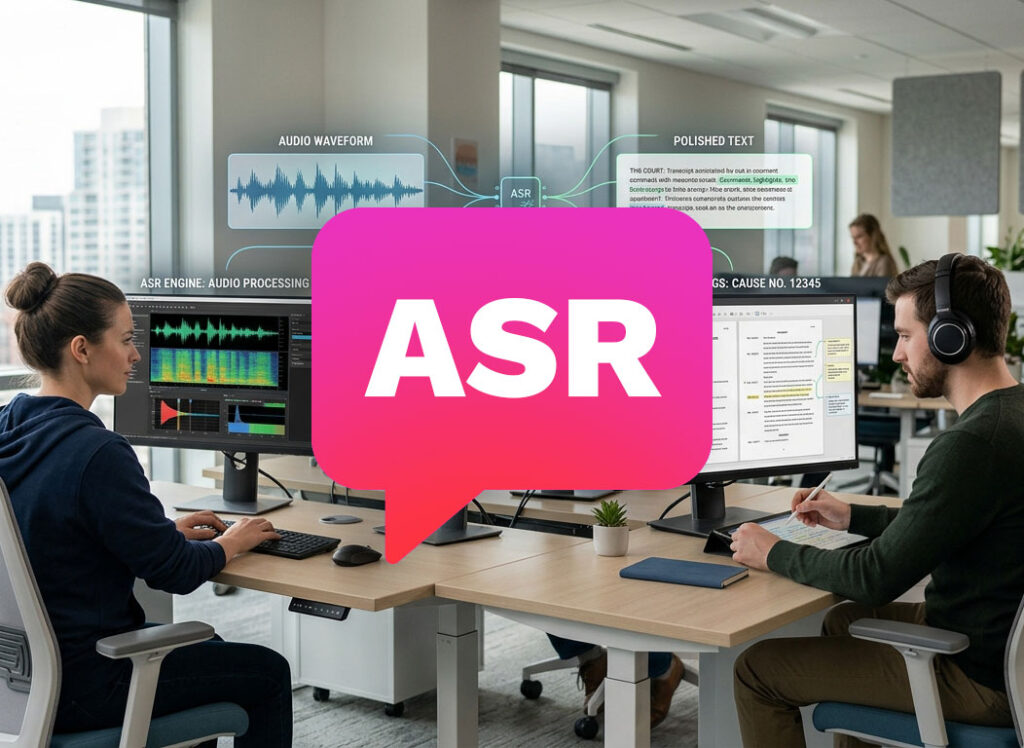
Our ASR — automatic speech recognition — produced a draft of that moment. It was not perfect. Someone knew precisely how imperfect it was, and against what standard. That is the part of the story that usually goes untold.
When people discuss speech recognition, they discuss the model. The model is real, and it matters. But accuracy in a legal record is not a single property. It is a model, and it is a standard. Those are built by two different kinds of people, and neither can ship without the other.
The Engineers: Building the Platform
Our ASR engineers own the system that turns machine-transcribed words into a speaker-identified transcript. Recognition alone produces a stream of text. A transcript requires structure: who spoke, where one speaker ends and the next begins, how the proceeding is segmented, how the output arrives in a form a scopist can actually work in.
That means owning the full pipeline — audio preparation before anything reaches the engine, model selection and configuration, speaker separation and identification, the delivery of results into WebScribe, and the production constraints that determine whether any of it is viable at volume: latency, throughput, reliability across thousands of hours of audio.
Courtroom audio approaches a worst case for a speech model. Commercial speech recognition is built for clean, close-mic’d, single-speaker recordings — a person speaking deliberately into a device held near their face. A hearing is the inverse. Microphones are fixed and shared. Speakers turn away from them. Rooms echo. People interrupt one another, trail off, correct themselves mid-sentence. The vocabulary includes case citations, statutory references, proper nouns that appear once and never again, and terminology whose meaning shifts with the nature of the proceeding. And the speakers reflect the full range of accents and speech patterns of the public a court serves — as they should, and as any system operating in a courtroom must be built to accommodate.
Our engineers approach that problem the way engineers do: measurably, repeatably, at scale. What they require is a target precise enough to configure against.
That target is anything but self-evident. That is where our team of experienced legal scopists and QA specialists comes in.
The Scopists and QA Specialists: Defining What “Correct” Means
Ask ten people what an accurate transcript looks like and you will get ten answers. Ask ten courts and you will get something more difficult still — ten answers, each internally consistent, each defensible, and mutually incompatible.
Jurisdictions differ on how speakers are identified and labeled. On how inaudible passages are marked, and when a passage should be marked rather than guessed at. On formatting, on certification, on the treatment of interruptions and non-verbal events. On terminology and abbreviation conventions. A transcript that would pass review without comment in one court would be returned in another — not because it is wrong, but because it is wrong there.
Our scopists and QA specialists are the people who convert that into something a machine can be measured against. They take a court’s requirements — some documented, many not — and produce a written standard. From the standard, a set of reference transcripts. From the reference set, an evaluation that engineering can run automatically, every time anything in the configuration or the pipeline changes.
That is the validation layer. We build one per jurisdiction, and we maintain it.
How the Two Teams Meet
The working cycle looks like this:
Collect → Configure → Measure → Repeat
Collect. We gather the audio that actually stresses the system, not the audio that flatters it — the difficult acoustics, the overlapping speech, the specialized vocabulary, the accents a general-purpose engine handles worst. Paired with reference transcripts built to a jurisdiction’s standard, that becomes the corpus we evaluate against.
Configure. Recognition quality in a courtroom is largely a configuration problem: audio handling and channel setup, domain vocabularies, speaker separation and identification parameters, how output is segmented and structured, and the settings tuned to a specific court’s recording conditions. This is where the engineering judgment lives.
Measure. The useful question is not how many errors but which errors. A two percent error rate concentrated in names, numbers, dates, and rulings is far more damaging to a legal record than a five percent rate distributed across filler words. So we grade error types, weighted by what genuinely matters in a transcript a court will rely on — against the evaluation sets our QA specialists built, court by court.
That last step is the hand-off, and it is why the two teams are inseparable. Engineering cannot configure toward a standard no one has articulated. QA cannot enforce a standard nothing is being measured against.
What the Validation Layer Prevents
The failure mode we are guarding against is a quiet one. A configuration change improves overall performance, the aggregate numbers rise, and everyone is satisfied — while quality degrades in a single jurisdiction that no one happened to check. Nobody notices until the court does.
Per-jurisdiction validation is how that is caught before release rather than after. The requirement is not that the system performs well. The requirement is that it performs demonstrably well, against that court’s own standard, before anything reaches that court.
Why This Matters Outside Our Walls
For a court or an agency, this surfaces in three ways.
Consistency. Your work is measured against your requirements, not a national average.
Turnaround without a quality trade. Speed purchased at the cost of accuracy is not speed; it is rework. The validation layer is what allows us to pursue one without quietly forfeiting the other.
Accountability. Improvements here are deliberate rather than incidental. There are people who own the platform, people who own the standard, and a defined process connecting them — which means we can always tell you what changed, and why.
Technology in this industry is frequently sold as though it removes people from the process. It does not. It changes which people, doing which work. Ours are engineers solving one of the harder problems in applied speech recognition, and specialists translating the requirements of individual courts into something that can be tested.
The transcript is the product. Both teams are why it holds up.
